
One Week Glacier National Park Itinerary


Our week-long itinerary in Glacier National Park gave us the perfect introduction to Montana’s famed park. The park was on our list for years, so we crossed over the border and set out to explore the American side of the Canadian Rockies.
Glacier National Park is renowned for its grandeur, wonderful hiking trails, backcountry adventures, and one of North America’s most epic drives. During our one week in Glacier, we explored both the East and West sides of the park, as well as the town of Whitefish.
We got a good taste of everything from scenic drives and hiking trails to fly fishing and even mini-golf. The park is very much family-friendly and a great place to reconnect with nature, which is exactly the purpose of a national park.
How To Plan A Trip To Glacier

The sweet spot for planning a trip to Glacier National Park is probably around five days. That will give you enough time to see the main sites, relax a little, and get on a few hikes.
To get a good feel, you’ll likely need a week, and if you’re up for even more exploration, 9 days would be enough time to see the Canadian side of Waterton Lakes National Park. Whitefish is a nice town worth visiting, but if nature is your priority, it could easily be cut.
We’ve included Waterton in this itinerary as we’re a little biased towards Canada, and it’s also a genuinely worthwhile addition. You could easily omit the park. This could also affect those flying to the region.
Where To Start Your Glacier Trip

There are three airports most commonly used for a trip to Glacier — Kalispell, Calgary, and Bozeman. Kalispell is the closest airport and best suited for those who want to visit Glacier on their own.
Calgary is a compelling option for those who would like to visit Waterton and possibly Banff. Bozeman is a bit further from Glacier, but many choose it for a trip to Yellowstone National Park in addition to Glacier National Park.
|
Airport |
Distance to Park |
Best Suited |
|---|---|---|
|
Glacier Park International Airport (Kalispell) |
35 mins |
Whitefish & Glacier National Park |
|
Calgary International Airport |
3:30 hours (border crossing) |
Glacier National Park, Waterton, & Banff |
|
Bozeman Yellowstone International Airport |
5:30 hours |
Bozeman, Yellowstone, & Glacier National Park |
Glacier National Park Itinerary
| Location | Days |
|---|---|
| Whitefish | 2 Days |
| Apgar | 2-3 Days |
| East Glacier | 2 Days |
| Waterton | 2-3 Days (optional) |
Whitefish

Whitefish is one of our favourite little towns, with its charming main street, great souvenir shops, excellent Montana vibes, art galleries, and plenty to do around town. The town centre is walkable, with a wide selection of restaurants and bars that feature live music in the evenings.

Check out Folklore for delicious coffee, Fleur Bake Shop for excellent pastries, and SM Bradford Co for western wear. When not exploring the town, there is a ton to do, including fishing, kayaking, biking, hiking, and whitewater rafting.
We actually did the itinerary in reverse as we were coming from our home in Banff, so we chose to relax and go for a swim in Whitefish Lake at Les Mason State Park.

We found Whitefish’s real appeal was its relaxed nature, not a destination to pack our days with experiences. It’s possible to use it as a base to visit Glacier National Park, but we found it a little far to enjoy fully. You’re better off staying in Columbia Falls, West Glacier, or Apgar.
Where to Stay


Some choose to use the town as a base to explore Glacier National Park, but the drive is a little far to the main sites. That said, the hotels tend to be nicer and more affordable than those near the park. We loved our stay at the newly renovated Grouse Mountain Lodge, which appears to be rebranding in 2027 as the Whitefish Lodge.

Apgar / West Glacier

You have several options to stay on the West side of the park, which makes a great base for exploring some of the best sites in Glacier National Park, such as Lake McDonald, Avalanche Lake, and the Going-to-the-Sun Road.
It’s also a nice spot to enjoy activities like horseback riding, whitewater rafting, and fishing. We suggest you check out Lake McDonald, go for a day hike, wander around West Glacier, and book a guided raft or fishing trip on the Flathead River.
If you can’t score a reservation in the area, it’s always possible to stay in Columbia Falls; it adds a little bit of driving and is less scenic. Below is what we suggest to do with your time.
Take in Lake McDonald

Lake McDonald is the largest lake in the park and the first big payoff as you head up the Going-to-the-Sun Road. The water is sparkling clear, and the mountains ringing the far shore make it one of the most photographed spots in Glacier. We loved catching sunset along the lakeshore!

There’s a small beach near Apgar Village where you can wade in, rent a kayak or paddleboard, or just sit with a coffee and watch the boats go by. If you only have time for one lake stop on the west side, make it this one.
Walk Along the Trail of the Cedars

This is one of the easiest hikes/walks in the park and well worth doing. It’s a short half-mile boardwalk through an old-growth cedar and hemlock forest. The vegetation here is wild and feels so different than the rest of the park, with its towering trees, cool temps, and lush forest floor.
It’s a highlight along the Going-to-the-Sun Road, so it can draw a crowd. Parking is also a bit of a challenge, as it’s also the start of the Avalanche Lake hike. Many hikers choose to combine the two hikes.
Hike To Avalanche Lake

This is the most popular hike in Glacier National Park and for good reason! It’s a moderate 4.5-mile hike through the beautiful cedar forest to a stunning alpine lake set in a huge amphitheatre. It’s so popular that the parking lot is full by 8:00 am in peak season.
Due to this, we highly recommend booking the hiker shuttle, which runs the length of the Going-to-the-Sun Road. It’s the most reliable way to do popular road hikes such as the Highline, St. Mary & Virginia Falls, and Avalanche Lake.
Get Out On The Flathead River

The rivers and lakes around West Glacier — the Middle and North Forks of the Flathead, plus Lake McDonald itself — offer some of the best fly fishing in Montana. We booked a half-day float with Glacier Anglers & Outfitters, which was perfect for us as first-timers. Our guide handled everything, and we still managed to land a few cutthroat trout.

Worth doing even if fishing isn’t usually your thing. Or you can always hop on a whitewater rafting tour down the same river for a slightly more thrilling experience. Glacier Raft Co has been operating on the Flathead River for over 50 years.
Explore West Glacier Village

Just outside the park entrance, West Glacier Village is a small cluster of restaurants, outfitters, and shops that makes a good stop before or after a day in the park.

It’s not much more than a few blocks, but it’s a convenient spot to grab supplies, book a rafting trip, or get a meal without driving all the way back to Whitefish. It’s a nice stop for an hour or so and a good spot to unwind or stay.

They also have the Golfing to the Sun Mini Golf, which is fun after a day of exploring the park – plus the pizza spot next to it makes for a good, relaxed evening. This is a hit with everyone, especially families.
Belton Chalet

Built in 1910 as the original gateway hotel for Great Northern Railway passengers, Belton Chalet sits right at the West Glacier entrance and is worth a stop even if you’re not staying there.

The Belton Chalet dining room and taproom are a nice way to end a day in the park, and the building itself is a piece of the same railway history you’ll see echoed at the Glacier Park Lodge and Prince of Wales Hotel later in the trip. We both went for the bison meatloaf and thought it was delicious.
Where to Stay

If you’re lucky enough to score accommodation, a stay on the southern end of Lake MacDonald, in the small village of Apgar, is inside the park. It’s situated on the south end of Lake MacDonald and surrounded by lush cedar forest. It’s a special place to stay, and we loved watching the sunset on the lake after a day of exploring the park.

We stayed at the Apgar Lookout Suites, a collection of comfortable and modern apartments. Our suite was huge, with enough room to comfortably accommodate a very large family. It featured a full kitchen, an outdoor deck, a spacious living room, a fireplace, a flat-screen TV, and more. Best of all, it was a short walk to the shoreline of Lake McDonald.
Going to the Sun Road

The Going-to-the-Sun Road is the premier attraction in Glacier National Park. It is a 50-mile-long scenic road that connects West Glacier and St Mary, going over Logan Pass. An engineering marvel and a testament to the will of man, the road cuts through the mountain slopes, hugs cliff edges, and provides extraordinary views from a car.

It’s best to drive the full length of the road and stay on both sides of the park. There are many scenic stops and worthwhile hikes along the road, so it can easily be explored over several days. We spent at least two full days on the road, enjoying some of the hikes along the way.
These are all the stops, hikes, and viewpoints that we stopped at along the road.
- Lake MacDonald
- McDonald Falls
- Trail of the Cedars / Avalanche Creek
- The Loop
- Weeping Wall
- Big Bend
- Logan Pass
- Jackson Glacier Overlook
- St. Mary Falls & Virginia Falls
- Sun Point
- Wild Goose Island Overlook
- St. Mary Lake
Logan Pass

Logan Pass sits at the very top of the Going-to-the-Sun Road, and it’s definitely the highlight of the drive. This is where the road crosses over the Continental Divide, and there are staggering mountain views in every direction.
Alpine meadows that cover the pass have an abundance of wildflowers and are home to a healthy population of mountain goats. We stopped at the pass twice to complete the two famous hikes that depart from it, and both times we saw numerous goats.
There is a visitor centre at the top of the pass with a moderately sized parking lot. However, the parking lot fills up quickly, and it has a 3-hour time limit. This means it’s best to take the hiker shuttle if you hope to enjoy the two of the best hikes in the park that depart from the pass.
- Hidden Lake
- The Highline Trail
Hidden Lake

Hidden Lake is a tremendous trail, and it is possible to complete the short hike in under three hours if you are parking at the pass. It starts off on a boardwalk through the meadows around the visitor centre before traversing through some steep terrain to an incredible viewpoint of Hidden Lake.

It’s almost impossible to not see mountain goats and bighorn sheep on the hike, so make sure to have your camera out. It’s a 2.7-mile round-trip hike and takes 1-2 hours to complete. If you’re early in the summer season, we suggest microspikes for your shoes, as the snow can take a while to melt.
The Highline Trail

Arguably Glacier’s wildest trail and a must for any avid hikers is the Highline Trail. It’s a point-to-point hike that starts from the visitor centre and runs along the Garden Wall.

It’s definitely not a trail for those scared of heights, as the trail quite literally skirts a huge cliff over the Going-to-the-Sun Road. However, this is also what makes the trail so incredible, as the views are jaw-dropping right from the parking lot.

The official trail end is at the historic Granite Park Lodge, but most day hikers continue down to “The Loop,” where the free hiker shuttle stops. The whole thing is our favourite trail in the park!
Saint Mary & Virginia Falls

You can combine two of the park’s prettiest waterfalls with a moderate hike. The biggest challenge for the hike is the extremely limited parking at the trailhead or nearby. So it’s another hike that’s best served by the hiker shuttle, but we did manage to park
A wildfire devastated the start of the trail, so there is little to no shade, so come prepared on a hot, sunny day. The good news is it’s quite cool at the St. Mary Waterfall, the first waterfall, and we even saw some brave individuals in bathing suits jumping into the water.

After St. Mary, the trail climbs into the forest and gains modest elevation. This leads to Virginia Falls, which is the larger and more dramatic waterfall. The small pools below the falls are also a great place to cool off. The full hike is just over three miles round-trip, so it’s approachable for most visitors.
Wild Goose Island

This is one of the most famous stops along the Going-to-the-Sun Road, with a dramatic mountain view, the stunning St. Mary Lake, and an iconic island. It’s a stop you can’t miss, similar to Logan Pass. Plus, it’s a very short walk from the parking lot along the road to the iconic viewpoint.
East Glacier
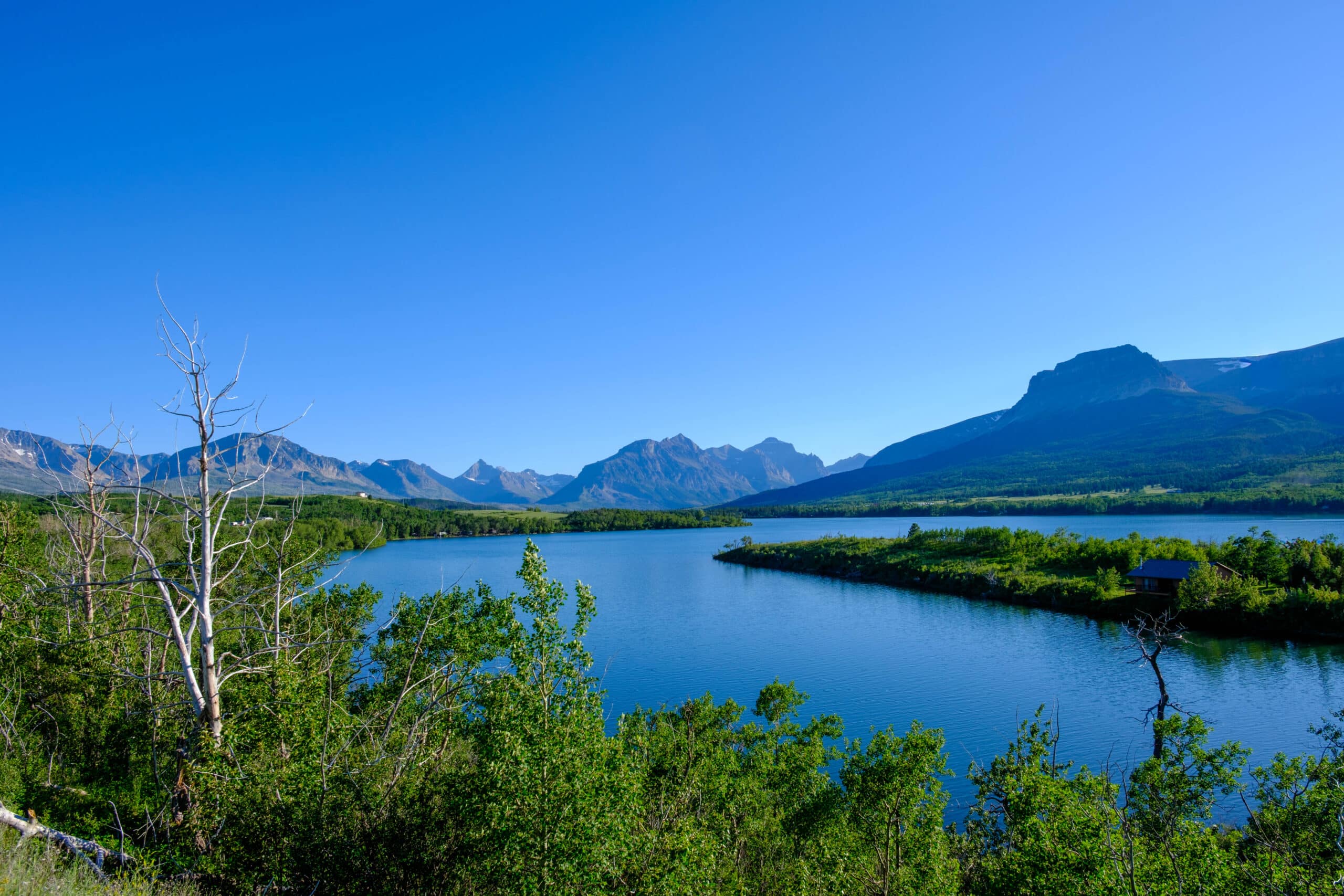
This is where we started our trip and used as a base to explore the Eastern side of the park, including Many Glacier, Two Medicine Lake, and Saint Mary Lake. East Glacier is largely undeveloped, so the park still feels raw, with many scenic natural sites and wonderful hiking trails to enjoy the outdoors. We highly recommend working in at least a night or two on the East side of the park.

We stayed at the Glacier Park Lodge, one of several historic lodges built by the railroads to welcome some of the first tourists to the mountains. There are several of these hotels, all worthy of a stay, such as the Prince of Wales Hotel, Many Glacier Hotel, and Lake McDonald Hotel.
Two Medicine Valley

Two Medicine is one of the quieter corners of Glacier, and one of the most rewarding if you make the drive. It’s off the main tourist circuit — no Going-to-the-Sun Road traffic here — which means the crowds thin out even in peak season, but the scenery holds up against anywhere else in the park. Sharp, glacier-carved peaks ring the lake, and it has a slower, more remote feel than the west side.
The easiest way to take it in is the Two Medicine Lake boat cruise, run out of the historic boathouse on the shore. The narrated ride takes you across the lake with a guide pointing out the surrounding peaks and park history along the way, and it also works as a shortcut — the boat drops hikers at the far shore to pick up trails to Twin Falls or Upper Two Medicine Lake without doing the full lakeside hike in both directions.
Many Glacier

Many Glacier is one of the most notable areas of the park and is widely considered the park’s most scenic area accessible by car. The area is home to several lakes, several hiking trails, a scenic boat cruise and a historic lodge.
If you only have time to pick one area on the east side of the park, make it Many Glacier. It’s the largest draw and the highlight of staying on the east side of the park.

The area is built around Swiftcurrent Lake and Lake Josephine, and the boat cruise here is regarded as the best in the park — a two-lake tour with a short hike between them that can be paired with a guided hike to Grinnell Lake. It’s a great option if you want the scenery without committing to a full day of hiking.

For hikers, though, Many Glacier is really about the trails. Grinnell Glacier is the classic — a strenuous but rewarding hike up to a viewpoint over the Glacier and its meltwater lake, and usually the number one hike on everyone’s list for this part of the park.

The trail was closed during our visit, so we pivoted to the Cracker Lake hike instead, a roughly 12-mile round trip through the valley to a striking, milky-turquoise lake set beneath Mount Siyeh. It’s a long day, but the payoff at the end is worth the mileage, and it’s a good alternative if Grinnell isn’t in the cards.

Other notable hikes in the area include the trail to Grinnell Lake itself (a shorter, easier version of the Grinnell Glacier hike), and Iceberg Lake, known for chunks of ice still floating in the water well into summer.
Where to Stay

We stayed at the Glacier Park Lodge in one of their newly renovated rooms, and it struck a nice balance — the rustic, historic charm of the original 1913 lodge is still very much intact, but the rooms themselves have been updated with new furnishings and, most importantly, renovated bathrooms – nice after a long day outside!

The lodge itself is worth the stay on its own merits — massive log pillars in the lobby, rocking chairs on the porch looking out at the mountains, and an easy walk to the Amtrak station if you’re arriving by train. Even if you don’t say it, it’s definitely worth stopping by if you’re in East Glacier.


It’s a convenient base for exploring both Two Medicine and Many Glacier, since it sits roughly between the two. We were also very fortunate that the hotel restaurant, The Great Northern, served some of the best food on the east side of the park.

If you’d rather stay closer to Many Glacier itself, the historic Many Glacier Hotel is the obvious choice, right on the shore of Swiftcurrent Lake with some of the best views of any lodge in the park. Just book early — like the other historic lodges here, rooms go fast for peak summer months.
Waterton Lakes National Park

We highly recommend driving across the Canadian border to visit Waterton Lakes National Park, which borders Glacier National Park and is part of an international Peace Park. The park is modest in size when compared to neighbouring Glacier National Park (USA) or Banff National Park. However, there are still many adventures and things to do in Waterton Lakes National Park.

You can enjoy Cameron Lake, hop on a scenic cruise along Upper Waterton Lake, hike the Crypt Lake Trail, one of the world’s most thrilling trails, or have a spot of afternoon tea in the historic Prince of Wales Hotel. That’s really just the start of things to do in the park!

We won’t dig into too much detail, but two to three days would be enough time to sufficiently explore the park. You can read more on what to do in Waterton in our post. Then there’s always the option to keep going further north and explore Banff on an extended Canadian Rockies road trip.
Hiking Gear We Recommend

It’s tough to beat the comfort and stability of the Speedgoat. A more technical shoe would be the Salomon X Ultra.

It’s always jacket season in the Rockies. We always carry a down jacket on every adventure.

This nifty clip from Peak Design secures a camera to my backpack strap for easy reach. No more digging in the backpack!


A lightweight backpack is perfect for most hikes in the Rockies. We suggest keeping it simple and carrying the basics.

In case of emergencies, we carry a GPS-enabled emergency beacon. Solid for regular backcountry users.


